
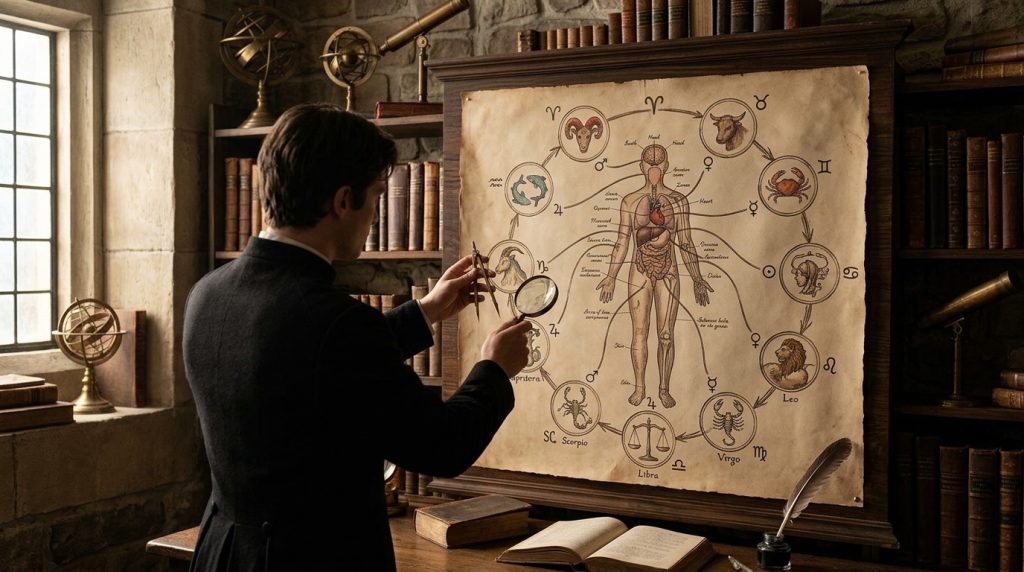
In medical astrology, the body is mapped through two overlapping symbolic systems: the twelve zodiac signs describe a sequence of anatomical zones, while planetary rulerships associate celestial bodies with particular organs and functions. These traditions offer a way to explore how astrology links the sky to the human form, but they are not a medical diagnostic method and do not establish scientifically verified causes of illness.
Astrological correspondences between planets, signs and body zones
Medical astrology assigns symbolic associations to both zodiac signs and planets. Signs are commonly linked to successive regions of the body, while planets are associated with broader functions, organs or qualities; an astrologer may then consider how these layers interact in a birth chart.
These traditions developed over centuries, drawing on ancient observations and theories of the body that differ from modern biology. Their value today is best understood as historical and interpretive: the correspondences may prompt reflection, but they cannot confirm a condition or determine an appropriate treatment.
Two distinctions help clarify how the system is read. A sign’s bodily zone is not identical to its ruling planet’s associations, and neither one offers a clinical assessment.
Zodiac signs as a head-to-feet map
The traditional sequence begins with Aries head and moves down the body toward Pisces and the feet. This descending map, often called the Zodiacal Man, provides a memorable framework for the signs’ anatomical symbolism.
Common associations include Taurus throat, Gemini’s arms and lungs, Cancer’s stomach, Leo’s heart and upper back, and Virgo’s intestines. Farther down the sequence, Libra kidneys and lower back, Scorpio reproductive organs, Sagittarius’s hips and thighs, Capricorn’s knees and bones, Aquarius’s ankles, and Pisces’s feet complete the traditional arrangement.
Planetary rulerships as functional symbolism
Planets add another interpretive layer. The Sun is often linked with vitality and the heart, the Moon with bodily fluids and digestion, Mercury with communication and the nervous system, and Venus with balance and the kidneys or throat. Mars is associated with heat and muscular action, Jupiter with growth and the liver, and Saturn with structure, bones, teeth and skin.

Some modern astrological traditions also connect Uranus, Neptune and Pluto with particular systems, but these associations vary and are less uniform than many classical rulerships. In every version, planetary symbolism describes an astrological vocabulary—not a verified account of how organs function.
Chart interpretation and the relationship between rulers
Once sign and planetary associations are distinguished, their relationship becomes easier to follow. An astrologer may look at a planet’s sign, house and aspects, but these factors remain symbolic indicators rather than evidence of disease or physical vulnerability.
For instance, Mars traditionally rules Aries, so a chart reading might consider both the sign’s head association and the planet’s themes of heat or action. That combination does not mean a person will experience headaches or injury; it simply illustrates how practitioners combine different layers of meaning.
| Astrological layer | Common examples | Role in interpretation |
|---|---|---|
| Zodiac sign | Aries and the head; Taurus and the throat | Maps signs to a sequence of body zones |
| Planet | Saturn and bones; the Moon and bodily fluids | Links planets to symbolic functions or organs |
| Chart relationship | A planet’s sign, house and aspects | Combines symbols within an astrological reading |
The table shows why no single placement should be interpreted in isolation. A sign may point to one body zone, while its ruling planet introduces a separate set of traditional themes.
Traditional rulers and modern variations
In traditional astrology, Mars rules Aries and Scorpio, Venus rules Taurus and Libra, Mercury rules Gemini and Virgo, Jupiter rules Sagittarius and Pisces, and Saturn rules Capricorn and Aquarius. The Sun and Moon rule Leo and Cancer respectively.
Elements as a broader interpretive layer
The four classical elements—Fire, Earth, Air and Water—offer another symbolic lens. Fire signs are associated with energy and heat; Earth with structure; Air with movement and communication; and Water with fluids and emotional responsiveness.
Medical astrology, historical context and health boundaries
Astrological approaches to health have a long history, especially in periods when astronomy, medicine and philosophy were closely intertwined. The Zodiacal Man appeared in historical medical imagery, where it offered a visual guide to the traditional sign-to-body sequence.
Historical origins and changing practices
Ancient Mesopotamian, Egyptian and Greek traditions contributed to the development of medical astrology, and its influence continued in parts of Europe through the Middle Ages and Renaissance. Practitioners historically consulted celestial patterns in connection with health, reflecting the medical theories of their time.
Responsible use of body astrology
For readers exploring body astrology, the safest approach is to treat planetary rulerships as a symbolic tradition. They may provide language for personal reflection, but they cannot predict illness, confirm symptoms or show whether a treatment will work.
For any health concerns or persistent symptoms, consult a qualified professional who can provide an evidence-based assessment and appropriate guidance.