
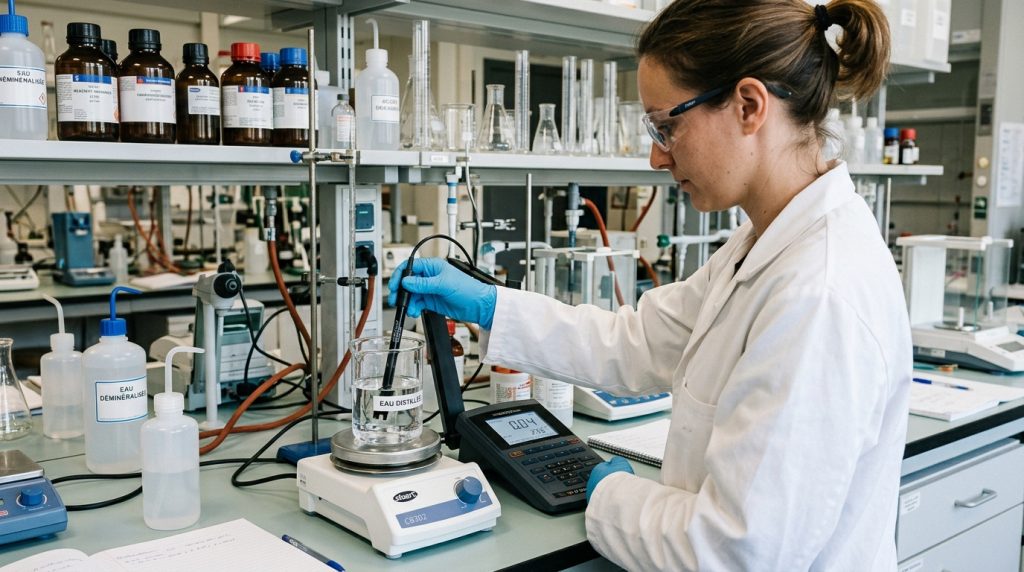
Distilled water is expected to contain very few dissolved ions, so its electrical conductivity is far below that of ordinary tap water. A reading below 0.5 microsiemens per centimeter (µS/cm) is often used as a stringent indicator of distilled water purity, but it is not a universal pass-or-fail limit.
Results depend on temperature, the meter, the container and how long the sample has been exposed to air. Carbon dioxide, for instance, dissolves into water and forms weakly ionized compounds, which can raise a reading even when the distillation process was effective.
Conductivity thresholds for distilled water purity
Electrical conductivity measures how readily water carries an electric current. In water, that ability mainly comes from dissolved ions, so a low reading generally indicates that few ionic substances are present.
Reference values and practical limits
A reading below 0.5 µS/cm is commonly treated as a stringent target for distilled water, while published reference ranges may extend from about 0.5 to 3 µS/cm. Some guidance gives a broader practical range, up to around 5 µS/cm, reflecting differences in equipment, handling and intended use rather than a single universal standard.
For context, exceptionally pure water at 25°C has a theoretical conductivity near 0.055 µS/cm. That figure describes highly purified water under controlled conditions; it should not be confused with the typical result from ordinary distillation, especially after storage or contact with air.
Reading ranges in context
Conductivity values are most meaningful when compared under similar conditions. A measurement should note the temperature and sample handling, since both can affect the result. The table gives useful reference points, not regulatory limits for every application.
| Water sample or condition | Approximate conductivity | What the reading suggests |
|---|---|---|
| Theoretical ultrapure water at 25°C | About 0.055 µS/cm | Extremely low ionic content under controlled conditions |
| Distilled water | Often about 0.5–3 µS/cm | Typical low-conductivity range; handling can shift the result |
| Distilled water using a stringent criterion | Below 0.5 µS/cm | A demanding target, not a universal standard |
| Freshwater streams | Often tens to over 1,000 µS/cm | Minerals and other dissolved ions produce much higher readings |
Thus, a result below 0.5 µS/cm supports a claim of low ionic contamination, but a result slightly above it does not automatically prove that the water is unsafe or improperly distilled. The intended use determines how strict the acceptance criterion must be.
Measurement practices for reliable conductivity readings
A suitable conductivity meter can detect small differences, but technique matters just as much as the instrument. Careful sampling helps distinguish genuine contamination from changes introduced during testing.
Meter setup and sample handling
Use a clean container and a meter with a range and resolution appropriate for low-conductivity water. Rinse the probe as directed by its manufacturer, avoid touching the sensor, and measure promptly; prolonged exposure to air can allow carbon dioxide to alter the sample.
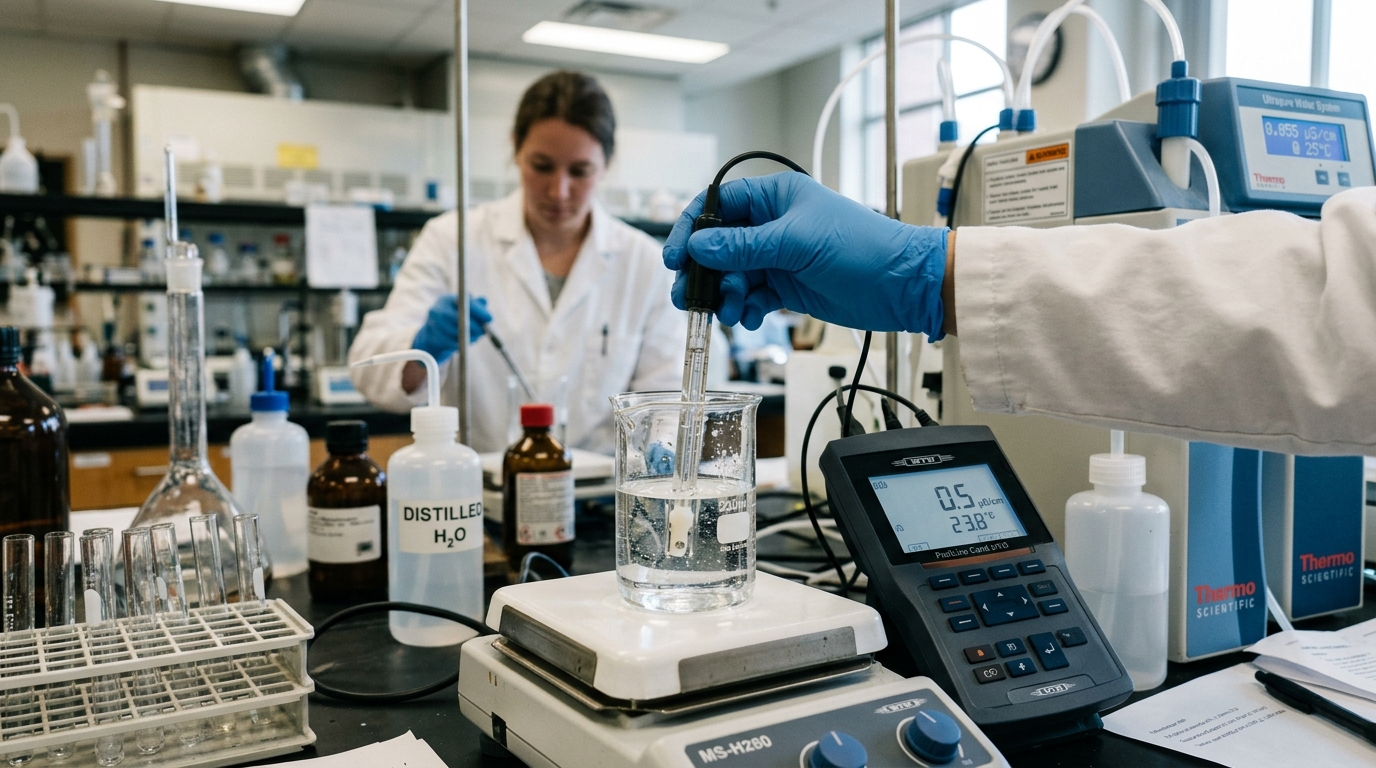
Temperature compensation is also important because conductivity changes with temperature. Record the sample temperature or use a meter that compensates automatically, and follow the instrument’s calibration instructions with suitable reference solutions. A poorly maintained probe may give unstable or misleading readings.
Common sources of variation
A conductivity result can rise for reasons unrelated to a failure in the distillation process. The following checks help identify likely causes before drawing conclusions:
- Air exposure: dissolved carbon dioxide can increase conductivity over time.
- Container residue: detergent, salts or minerals left on glassware may contaminate the sample.
- Probe condition: deposits, damage or poor calibration can distort the measurement.
- Temperature differences: readings taken at different temperatures may not be directly comparable.
When the result is unexpected, repeat the test with a fresh sample and clean equipment. Consistent measurements are more informative than a single isolated value.
Purity checks beyond water conductivity
Conductivity primarily reflects ionic substances; it does not identify every contaminant. Distilled water may still be affected by microorganisms, organic compounds or leaching from unsuitable storage materials, so water purity standards depend on the intended use.
Complementary water quality testing
Other tests can reveal characteristics that conductivity cannot. Their usefulness varies: a quick field check may be enough for routine monitoring, while sensitive laboratory or industrial applications may require validated analytical methods.
- Total dissolved solids (TDS): estimates the combined concentration of dissolved material, often from conductivity, but does not identify individual compounds.
- pH: indicates acidity or alkalinity; readings can shift as carbon dioxide enters the sample, so distilled water may not show a stable neutral value.
- Total organic carbon (TOC): assesses organic contamination that a conductivity meter may not detect.
- Microbiological analysis: checks for bacteria and other organisms when sanitary quality matters.
Visual clarity and lack of odor are useful observations, but they cannot establish chemical or microbiological purity. Likewise, a low TDS result is not a substitute for identifying specific contaminants where those substances pose a concern.
Interpretation by intended use
For general screening, conductivity offers a fast indication of dissolved ionic content. Drinking-water safety, however, cannot be established by conductivity alone: distillation does not protect water from contamination introduced during collection, bottling or storage.
In laboratories and technical processes, acceptance limits should follow the applicable method or water purity standards for that use. A suitable report pairs the conductivity level with temperature, sampling conditions and any additional tests required by the application. That context turns a number into a meaningful quality assessment.
In practice, below 0.5 µS/cm is a strong low-ion benchmark, while the broader 0.5–3 µS/cm range is commonly reported for distilled water. For a result tailored to a particular purpose, consult a qualified water-testing professional or laboratory.